9 Oct 2026
- Community & News
- Service Line
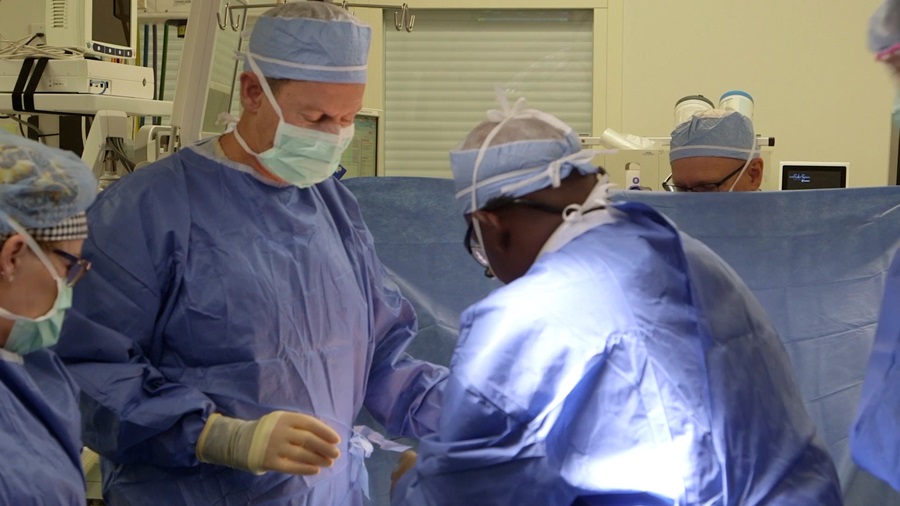
A new surgical approach is quietly changing what patients can expect after lung surgery, and at TriHealth, it’s already being used.
Called single-port lung surgery, this technique represents the next step in a decades-long shift toward less invasive care. While the procedure itself isn’t new, the way surgeons are able to perform it is evolving in a way that could significantly improve recovery.
Not long ago, lung surgery meant a large incision (sometimes 7 inches), spreading the ribs, and nearly a week in the hospital. Over time, that evolved into minimally invasive and robotic techniques, where surgeons could operate through several small incisions instead of one large one.
Now, single-port surgery takes that one step further. Instead of multiple entry points, surgeons operate through just one small incision, without changing the surgery itself.
As TriHealth thoracic surgeon Dr. Doug Adams explains: “The benefits primarily of single port are not that you're doing a better operation. You're still doing the same good operation. It's just how you get there is less insulting to one’s body.”
At first glance, reducing from several small incisions to one might seem incremental. But inside the body, it can make a meaningful difference. Every incision, no matter how small, triggers an inflammatory response. Reducing the number of entry points reduces that impact.
“With each incision… you get some stimulation of the inflammatory response… You cut that down to one, and then you can follow the logic there.”
Fewer entry points also mean less disruption to the nerves that run between the ribs, which is one of the main sources of pain in traditional lung surgery.
“One of the advantages of moving to single port… is you're not injuring those nerves. So, the incidence of acute and chronic discomfort should be considerably less.” TriHealth’s Dr. Adams explains.
For patients, those technical differences translate into something much more tangible: how they feel after surgery. Early experiences with the procedure are already showing promise.
Dr. Adams describes checking in with an early patient of this upgraded surgery:
“I had to make her tell me she had pain… it was that minimal.”
While every patient’s recovery is different, single-port surgery is designed to support:
It’s part of a broader push in surgery, which is not just treating the condition, but minimizing the toll of treatment itself.
For Dr. Adams and his team, this advancement is part of a much bigger picture.
Lung cancer remains the most lethal form of cancer, but outcomes improve dramatically when it’s caught early and treated effectively. While surgical techniques are advancing, he emphasizes that the biggest opportunity is still early detection and access to care, which highlights the important population health model at TriHealth.
At the system level, TriHealth is continuing to build a comprehensive approach that includes screening programs, advanced diagnostics, robotic surgery, and personalized treatment approaches. Together, these pieces create a more complete path from detection to recovery.
As Dr. Adams sees it, the significance of innovations like single-port surgery goes beyond a single procedure. Instead, it reflects something larger about the system of care surrounding it.
“There is no system in Cincinnati that has really laid claim to lung cancer,” he said. “But in TriHealth’s system, from start to finish, we have spectacular physicians, personnel, and a very high-tech approach, from genetics to AI to surgery.”
That broader coordination, from screening to treatment to recovery, is what continues to shape how lung care evolves closer to home through TriHealth.