Leading Through Expertise and Innovation: TriHealth Performs 15,000th Robotic-Assisted Surgery
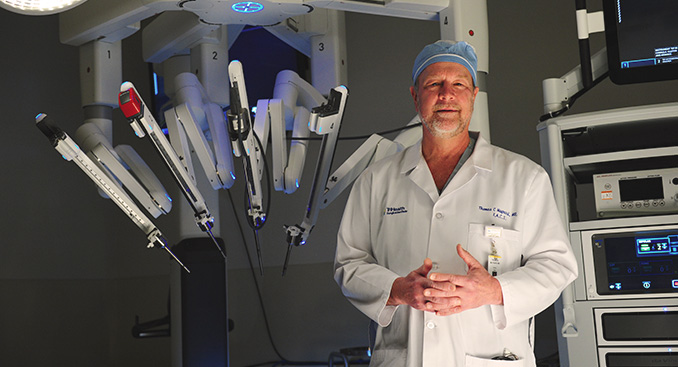
Thirteen years after performing the first robotic-assisted surgery in Cincinnati, TriHealth surpassed a significant milestone recently with an esophagectomy that marked the system’s 15,000th robotic-assisted surgery. As national leader in minimally-invasive robotic-assisted surgery, TriHealth performs more robotic procedures than any health care system in Ohio and is in the top one percent nationally when it comes to volume procedures performed, according to data from Intuitive Surgical, Inc.
The esophagectomy was performed by Erik Dunki-Jacobs, MD, a surgical oncologist with the TriHealth Cancer & Blood Institute, in conjunction with radiation treatment and chemotherapy for the successful treatment of esophageal cancer. The patient, Larry Dulli, is now cancer free thanks to robotic technology and a multi-disciplinary approach to his treatment.
TriHealth surgeons are using robotic technology to perform many complex procedures throughout the body, including the esophagus, heart, lungs, pancreas, bladder, kidneys, colon and male/female reproductive organs and glands.
“We’re really fortunate to have a lot of experience with robotic-assisted surgery,” says Dr. Dunki-Jacobs. “It’s an advantage for our patients.”
The advantages of robotic-assisted surgery include:
- Increased precision allowing for delicate cutting and stitching not possible through other minimally-invasive techniques.
- Smaller incisions, often the size of a dime, that can mean less pain compared to open surgery.
- A quicker recovery and less time spent in the hospital because of the small incisions and less disturbance inside the body.
- Better vision for surgeons through the use of a 3D camera which gives them a view 10 times better than the human eye.
- Less blood loss and risk of infection due to minimal incisions.
Advanced Minimally-Invasive Technology
Robotic-assisted surgery is performed by highly trained surgeons using a robotic system. Miniaturized medical instruments are inserted through small incisions and controlled by the surgeon via a console next to the patient. The instruments are wristed, allowing them to turn and maneuver with ease and they are able to bend far beyond the ability of the human hand, giving the surgeon even more precise control than laparoscopic tools.
One of the robotic arms holds the 3D camera, which sends high-definition, magnified images to a monitor with a better view than through 2D laparoscopy or the human eye.
“The visibility of the anatomy is unmatched,” says Thomas Maynard, MD, (*formerly) director of the Division of Hepatopancreaticobiliary Surgery for the TriHealth Surgical Institute. “I’m able to dissect into tissue planes that I thought would be impossible.”
The robotic system also offers increased stability and precision by managing the level of force applied by the surgeon and removing any random movements.
On the Leading Edge of Care and Innovation
The 15,000th procedure is only the latest milestone for TriHealth’s Robotic-assisted surgery program. The test of any surgical program is in the outcomes for its patients and TriHealth continues to pair innovative technology with providing the best care for the best possible outcomes. As a national leader in robotic-technology, however, TriHealth has achieved some notable milestones, including:
- The first robotic-assisted surgery in Cincinnati, a coronary bypass surgery performed by a cardiac surgeon with the TriHealth Heart & Vascular Institute.
- The first minimally-invasive pancreatic surgery in the region, performed by Thomas Maynard, MD.
- Prevention of pre-term birth, the leading cause of death for children under five, through the only robotic-assisted trans-abdominal cerclage procedure in the region, performed by William Schnettler, MD with TriHealth’s Tri-State Maternal Fetal Medical Associates.
- Reduction of patients having lung surgery requiring a thoracotomy to around 50 percent versus a nationwide percentage of around 90 percent.
- A TriHealth cardiac surgeon training surgeons from across the U.S. and around the world in robotic-assisted cardiac surgery.
These milestones are possible because of a team of highly-qualified surgeons and investments in leading robotic technology backed by a team committed to providing excellent compassionate care.
“You’re very reliant on your team with robotics,” says Kathryn Lynne O’Keefe, MD, a thoracic surgeon with the TriHealth Heart & Vascular Institute. “We’re lucky at TriHealth to have dedicated and highly skilled surgical assistants and team members. They’re very experienced with robotics and committed to excellence. I’m thankful for every one of them.”
*All providers were employed by TriHealth at the time of article publication
Related Articles
- Community & News
- Service Line
- Community & News
- Conditions & Care
- Service Line